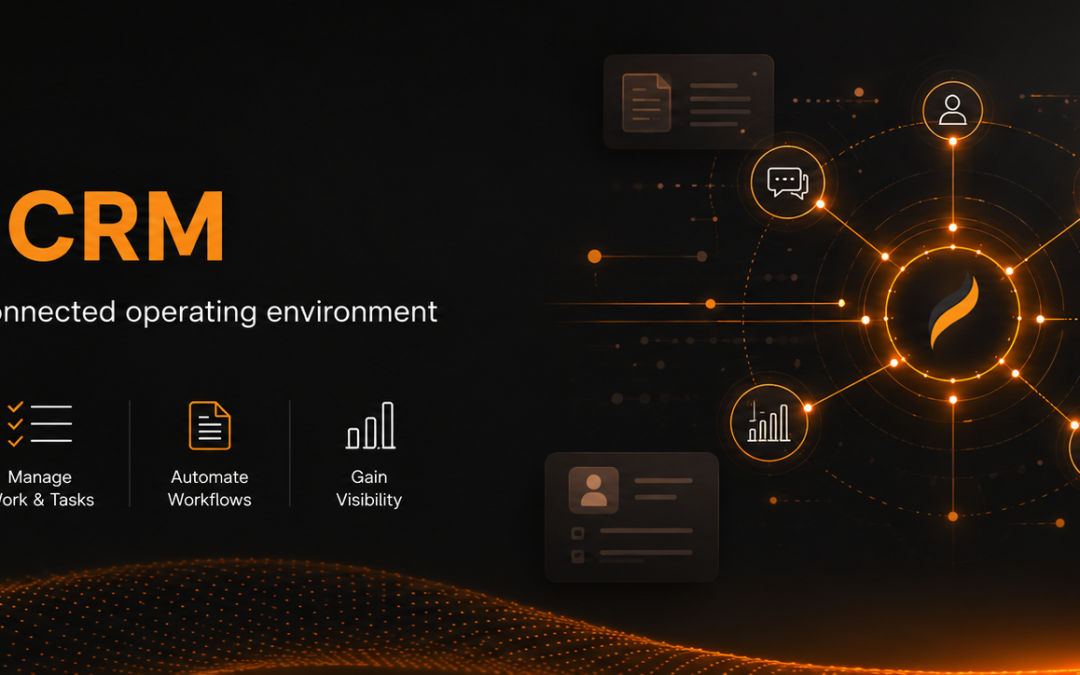
A CRM should do more than store names and contact details. The real opportunity is to connect client information, documents, communications, tasks, workflows and management insight in one operating environment.
The CRM problem has changed
Most organisations no longer struggle because they have too little software. They struggle because they have too many disconnected tools. A traditional CRM may hold contact details and interaction notes, while documents sit in shared folders, emails remain in individual inboxes, tasks are managed separately and management reports are assembled manually. Each tool may work, but the business as a whole becomes harder to see and control.
This is why the question is no longer simply, “Do we have a CRM?” The better question is, “Does our operating environment help people complete work consistently, find information quickly, evidence what happened and understand what requires attention?”
From client database to operating environment
A modern platform should connect the information and activities that form the client relationship. That includes client and entity profiles, documents, communications, tasks, workflows, reviews, service requests, audit trails and reporting. When these elements are connected, staff spend less time searching and recapturing, managers gain clearer visibility and clients receive a more consistent experience.
pfireStorm already provides a central environment for CRM, document management, communications, tasks, workflows and reviews. This gives businesses a practical foundation from which to reduce fragmentation and manage work around the client rather than around separate software products.
Why connection matters
Connection is valuable because business risk often exists between systems. A document may have been received but not linked to the correct client. An important email may remain visible only to one employee. A task may be discussed but never formally allocated. A review date may exist in a spreadsheet that management does not routinely monitor. None of these problems is dramatic on its own, but together they create delays, duplication, poor service and weak audit evidence.
A connected operating platform creates a shared version of the truth. People can work from the same information, responsibilities can be allocated, progress can be monitored and activity can be traced. The result is not simply more technology. It is better operational discipline.
The next stage: intelligence
The pfireStorm Evolution programme is building on this established foundation. Its direction is towards an intelligent business operating system in which structured information, richer business intelligence and AI-assisted capabilities support better productivity and decision-making. These future capabilities are intended to strengthen professional judgment, not replace it.
The businesses best prepared for this next stage will be those that organise their information and processes now. Reliable data, visible workflows and clear accountability are the foundations on which useful intelligence is built.
A practical first step
Before purchasing another isolated tool, map how one client relationship moves through your business. Identify where information is duplicated, where documents are stored, how tasks are allocated, how follow-ups are monitored and how management obtains a complete view. The gaps will show whether your business needs another application—or a more connected operating environment.
Contact Us