
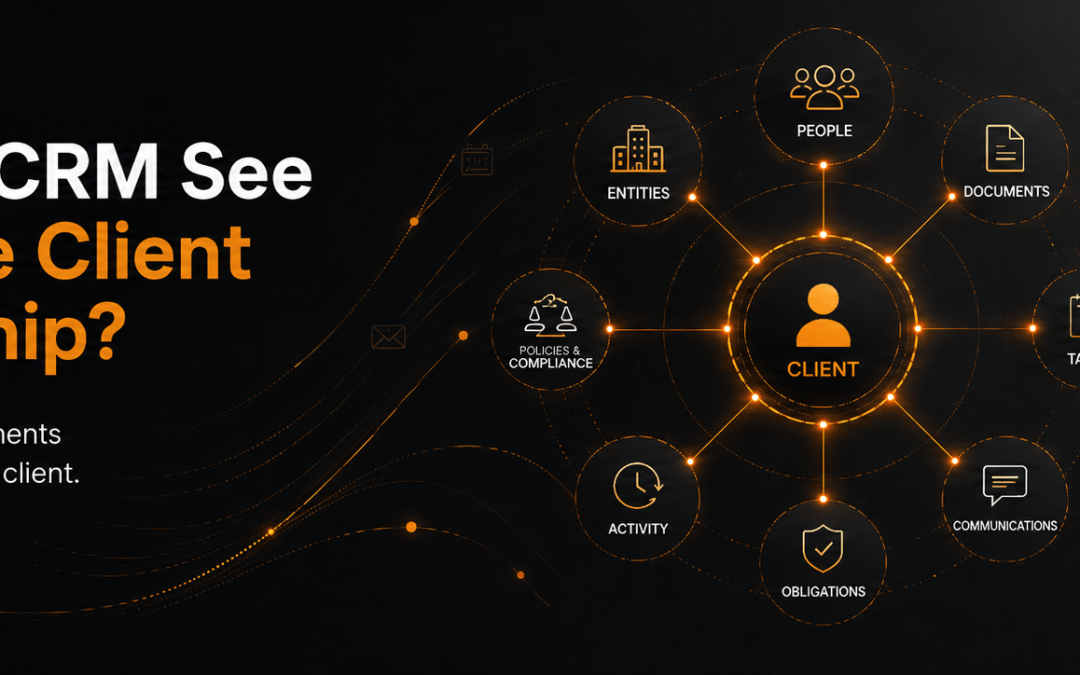
A client rarely exists as a single isolated record. The complete relationship may include a family, trust, company, beneficiaries, business partners and financial arrangements.
The isolated client record is no longer enough
Traditional CRM systems often store each person or organisation as a separate record. That may be sufficient for basic contact management, but it does not reflect the way professional relationships work. An individual may be a spouse, parent, director, shareholder, trustee, beneficiary, business owner and policyholder at the same time.
Important decisions can be missed when these relationships are not visible. A change in one part of the structure may affect financial planning, estate planning, beneficial ownership, succession, risk or ongoing service elsewhere.
Context improves service and advice
A connected view helps the professional understand who and what forms part of the client’s world. Communications can be interpreted with better context. Reviews can consider related entities and family members. Advice can take account of business interests, liabilities, dependants and estate-planning consequences.
It also supports continuity. When another employee assists the client, they can see the relevant relationships rather than relying on the memory of the person who established them.
Relationship information supports compliance
For compliance-driven businesses, relationship visibility is not merely useful—it may be necessary. FICA, KYC, beneficial ownership and risk assessment often require an understanding of the people behind an entity and the roles they perform. An isolated company record without linked directors, shareholders or beneficial owners provides an incomplete picture.
pfireStorm already supports client grouping, relationship information, central records, documents and communication histories. These tools help businesses organise connected people and entities around the relationship being managed.
From grouping to relationship intelligence
The pfireStorm Evolution direction includes deeper relationship intelligence across individuals, families, trusts, companies and other entities. The objective is to make connections more visible and useful for servicing, compliance, reporting and opportunity identification.
As with all data, only relevant and appropriately obtained relationship information should be captured. POPIA, confidentiality and access control remain important. The purpose is not to collect information indiscriminately, but to record what the business genuinely needs to serve and manage the relationship.
Review the whole relationship
Choose several important clients and map the people, entities, products, documents and obligations connected to them. Then compare that map with what staff can see in the CRM. Any missing connection may represent a service gap, compliance risk or opportunity to improve the quality of advice.
Contact Us