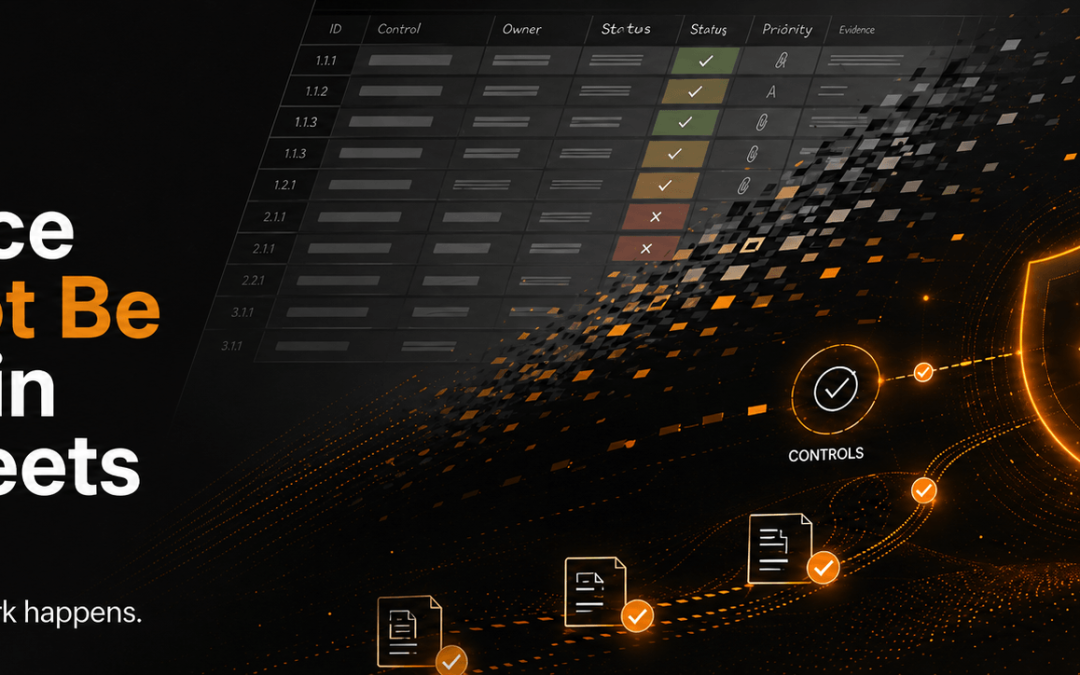
Compliance becomes fragile when evidence is scattered across spreadsheets, folders and inboxes. Stronger control begins by connecting compliance to normal business activity.
Why the spreadsheet becomes a risk
Spreadsheets are flexible and familiar. They are useful for calculations, short-term analysis and simple registers. The problem arises when a spreadsheet becomes the main control for obligations that require evidence, ownership, deadlines, approval and a reliable audit trail.
A compliance spreadsheet may indicate that an item is complete, but the supporting document may be stored elsewhere, the relevant communication may sit in an inbox and the person responsible may have changed. Management can see the status claimed in the spreadsheet without seeing the complete evidence behind it.
Compliance is made up of connected activities
For Financial Services Providers and other compliance-driven organisations, obligations may include FICA and KYC, AML controls, risk ratings, beneficial ownership, POPIA, TCF, advice records, client reviews, complaints, communications and audit trails. These are not isolated administrative exercises. They arise during onboarding, advice, servicing, review and ongoing client management.
When compliance is managed separately from the work, staff must duplicate information and reconstruct evidence later. This increases workload and creates the possibility that an important step will be missed.
Build evidence as the work is completed
A stronger approach is to link the requirement to the client, document, communication, task or workflow concerned. Responsibility should be allocated, due dates should be visible and completion should be supported by evidence. Exceptions should be identifiable before an audit or review takes place.
pfireStorm already supports central client records, document storage, communication histories, tasks, reviews and audit trails. These functions can help a business create a more complete and accessible evidence base.
Technology does not replace governance
No platform can make an organisation compliant merely by being installed. Policies, responsible people, appropriate advice, supervision and management review remain essential. Technology supports these responsibilities by making the process more visible, repeatable and auditable.
The pfireStorm Evolution direction is towards compliance that is increasingly embedded in workflows, measurable through business intelligence and supported by exception management. This is intended to reduce last-minute file reconstruction and improve control during the normal course of work.
Use spreadsheets in the right role
The lesson is not that spreadsheets should never be used. It is that they should not become the sole source of truth for complex obligations. Use them where they add value, but ensure that core client records, evidence, responsibilities and activity histories are controlled in an environment designed for ongoing operational management.
Contact Us