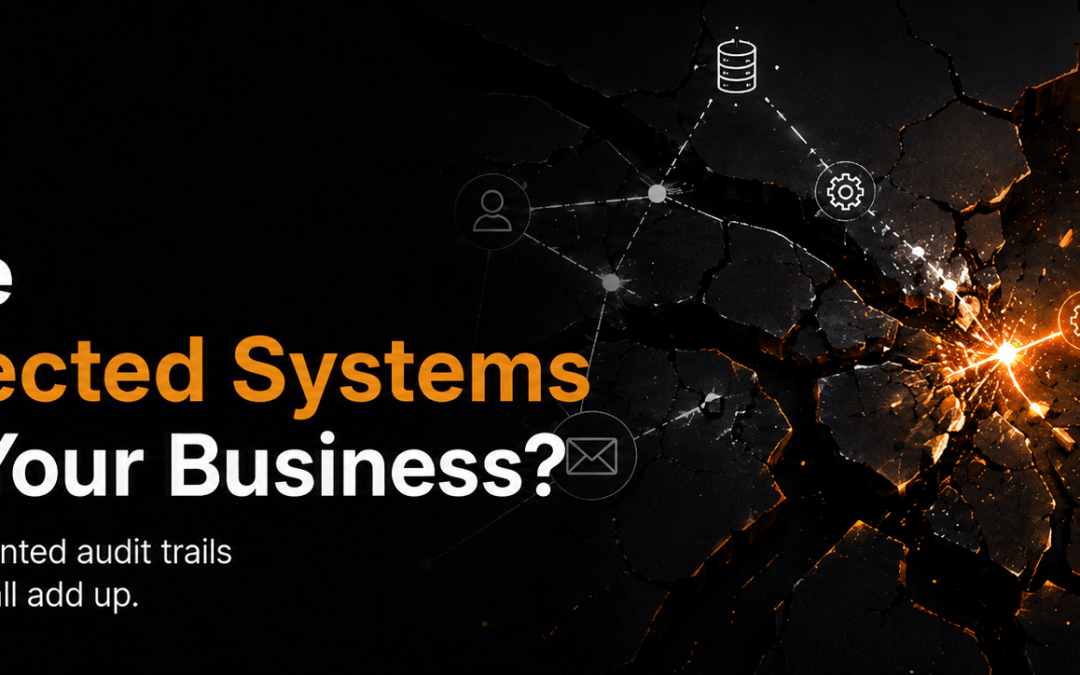
The subscription price of each system is only part of the cost. Disconnected tools also consume staff time, fragment audit trails and make management information harder to produce.
Software sprawl often develops quietly
Businesses rarely set out to create a fragmented technology environment. It happens one problem at a time. A spreadsheet is introduced to track reviews. A shared drive stores documents. A separate task tool is added for follow-ups. Compliance information sits elsewhere. Reporting is then created manually by combining information from several sources.
Over time, the organisation may use many systems to manage one client relationship. The monthly subscriptions are visible, but the larger operational cost is often hidden.
The hidden costs
The first cost is duplication. The same client details may be captured in more than one place, increasing workload and the chance of inconsistency. The second cost is delay. Staff must search across folders, inboxes and systems before they can act. The third cost is poor visibility. Managers cannot easily see outstanding work, bottlenecks or risk without asking several people or compiling a manual report.
There is also a control cost. When communications, documents and actions are separated, the audit trail becomes fragmented. It becomes harder to prove who did what, when it was done and what information supported the decision.
Calculate the cost of friction
A useful assessment is to measure the time spent on “system friction”. Ask staff how often they recapture information, search for documents, request an email history, reconcile spreadsheets, prepare reports or check who is responsible for an action. Multiply that time across the team and across the year. The result may be far greater than the cost of the software itself.
Friction also affects clients. Repeated requests for the same information, slow responses and inconsistent handovers can reduce confidence even when employees are working hard.
Consolidation does not mean one tool for everything
No platform should be expected to replace every specialist system. The objective is to decide which information and processes should be central, which specialist tools remain necessary and how the complete operating model will be controlled. A strong central platform should reduce unnecessary duplication and provide a consistent place from which the client relationship and related work can be managed.
pfireStorm already brings together client information, documents, communications, tasks, workflows and reviews. Its Evolution direction is to extend these foundations with stronger compliance visibility, business intelligence and AI-assisted productivity.
Start with the client journey
Map the systems touched from the first enquiry through onboarding, service, review and retention. Mark every point at which information is re-entered, transferred manually or becomes invisible to another person. These are the places where cost and risk accumulate.
The goal is not to own fewer systems for its own sake. The goal is to create a simpler, more visible and more reliable way of working.
Contact Us